
Kate’s story – “I’m a classic example of a sandwich carer”
Kate reflects on the challenges of being a sandwich carer and shares how her Admiral Nurse has supported her family.
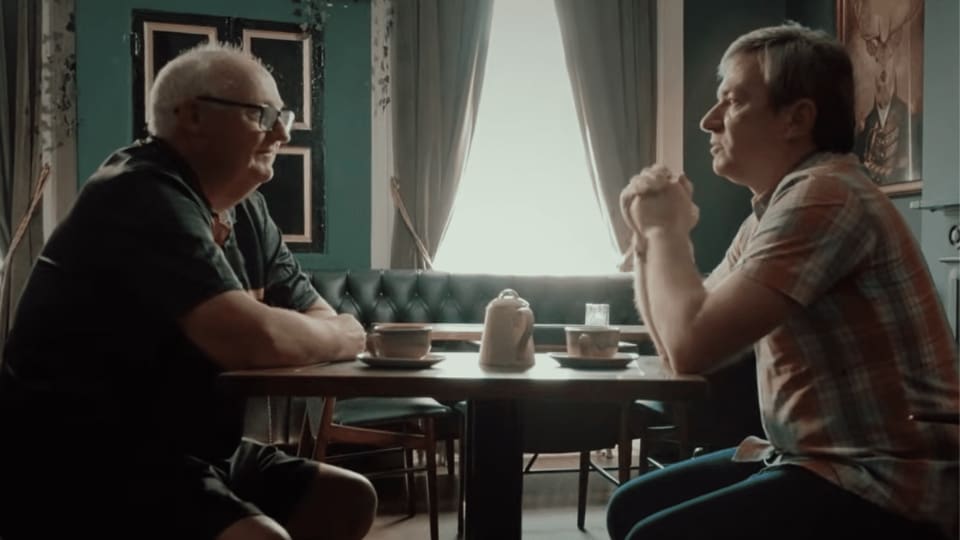
Tommy, who lives with Alzheimer’s disease, and Andrew, who cares for his mother, talk about their experiences with dementia. They touch on fear, grief, guilt and their hopes for the future.
Tommy: I was initially diagnosed with bipolar disorder, but my wife pushed for a second opinion. Over the following months, I had lots of brain scans, which led to me being diagnosed with young onset Alzheimer’s disease. I had just turned 58.
Andrew: My mum was diagnosed with vascular dementia in 2020 at the age of 75. When she was diagnosed, we were left to get on with it. The only support we were given was a leaflet. With any another diagnosis, like cancer, there is a very clear support pathway.
Tommy: Even after the diagnosis, I couldn’t believe that I had dementia. I was in denial. My daughter struggled to talk about it, and my son couldn’t even say the word ‘dementia’. Nobody spoke openly to me about it or asked me how I was feeling. But I could sometimes hear them talking about me in the other room.
Even the GP stopped speaking to me during my appointments and would speak to my wife instead. Dementia is complex, and GPs only get a small amount of training on it. That’s why dementia specialist Admiral Nurses are a godsend.
Andrew: Our interaction with dementia before Mum’s diagnosis was very limited. We were spinning around in circles looking for information, trying to understand what dementia meant for us and how it was going to change our family dynamics. I saw my dad in tears one day through the doorway, and that’s when I realised that we were spiraling.
Our local memory service suggested that I get in touch with an Admiral Nurse. She was our lifeline and her support took us out of freefall. I was trying to hold the family together and I felt like I was failing as I couldn’t get them to accept Mum’s diagnosis. But when I started getting information from the Admiral Nurse, they accepted it more easily as it was coming from a professional who specialised in dementia. The support we received was amazing and I genuinely don’t believe we would have gotten through the first year without it.
Andrew: My dad couldn’t understand that Mum wasn’t going to get better. He thought he could fix everything which, in turn, made us clash.
As men, I think we struggle to talk about our emotions. If something frightens us, we ignore it and step away. We think that if we don’t talk about it, it’s not going to hurt us. We’re almost fearful of being fearful and focus on fixing the issue.
Tommy: People don’t realise how heartbreaking dementia is, and it’s really hard to talk about. When I was diagnosed with dementia, it was the lowest point in my life, and I thought it was the end of the world. But you have to talk about it. If you bottle it up, it will just wear you down. It’s important to speak to people who have empathy rather than sympathy.
Every day, I feel like I’ve run a marathon. It’s like I’ve been on a treadmill running and running, but I’ve stayed in the same spot. There are days when I’m at rock bottom and I can’t get out of bed. I feel as if the weight of the world is on my shoulders.
But I feel like I need to toughen up in front of my friends. I don’t feel like I can say, “I’ve had a terrible day, I feel like I can’t go on.” I think they would tell me to pull myself together. My friends talk to me about football and golf, but never dementia. There’s a lot of fear around dementia.
Andrew: My dad died last April, and there’s no doubt that he died of a broken heart. He had been married to Mum for 65 years and spent the last four years of that journey grieving for her and missing her.
It was only when I was grieving for Dad that I realised that I’d already spent the last year grieving for Mum, even though she is still here. I can still go and visit her, but she isn’t the same person she was before dementia.
Tommy: I grieve a lot of things. I grieve for what I’ve robbed my wife of. I feel like I’ve taken away her independence. I grieve that I’m not the husband that I should be.
I grieved when I had my driving licence taken away. I grieved when I lost my job and then the house we’d worked all our lives for. My wife says that she is happy where we are now, but I know it broke her heart. I know she puts on a brave face for me.
I really miss the person I was before dementia. I feel as if I’ve been transported into a different dimension.
Andrew: My mum and dad used to own pubs, so I grew up around live bands and juke boxes. Mum loved Northern Soul and Johnny Cash was one of her favourite artists. I’ve seen her embrace music, and it’s always helped her through life.
Music has a way of calming Mum down and soothing her. You can see in her facial expression that she really enjoys it. I think music helps her to connect to memories of when she was younger.
Tommy: I’ve got a friend who’s the same age as me who also has Alzheimer’s disease. He’s a musician and we’ve recorded some songs together.
I find that music is one of the greatest therapies. Music calms the savage beast that is dementia. There is a rage inside of me that I am always suppressing, and music fights it. It makes it go to sleep.
Tommy: I always say you must think of dementia like a battery. You need the negative and the positive ends to make a torch shine brightly. If it’s all positive or all negative, it won’t work.
Andrew: Living with dementia is a balancing act. I was Mum’s carer, but I was also her son and tried to remember the joyful times. You have to balance two worlds. Sometimes they collide, but they can also live in harmony.
Kate reflects on the challenges of being a sandwich carer and shares how her Admiral Nurse has supported her family.
Mike reflects on the importance of the Nationwide Building Society dementia clinics in North Ayrshire, Scotland.

Harjit reflects on the support she received from Admiral Nurse, Tina, whilst her mum was in hospital.