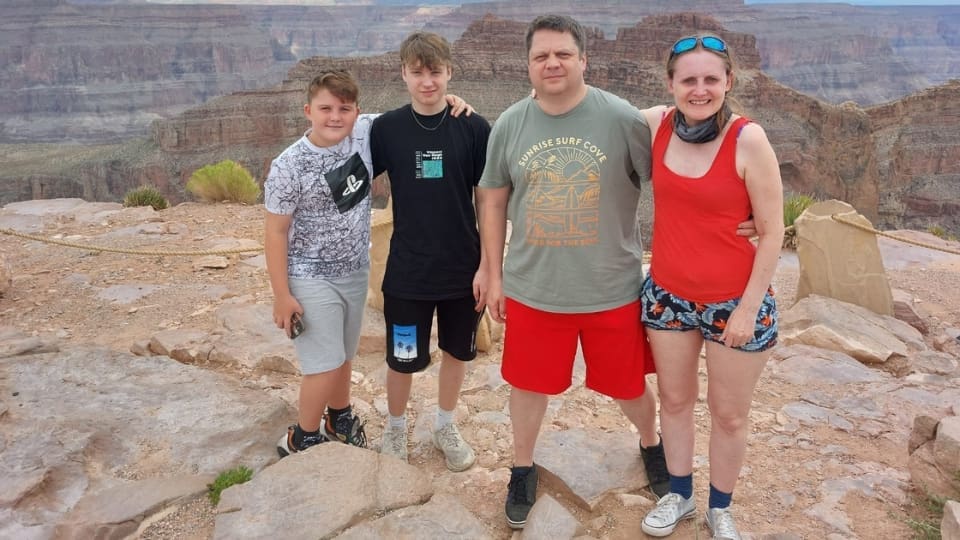
“It was confusing and scary” – Euan
Lewis: I was 17 years old when Mum started showing signs of dementia. The changes were gradual at first. But over time, we became more concerned as she wasn’t behaving like herself.
The first time I realised that something was seriously wrong was when Mum was driving to our grandma’s house. We were going down a dark country lane, and she forgot how to turn the headlights on. I told Mum to stop the car, but she couldn’t register what I was saying. I had to reach over and slam the brake pedal with my hand to get the car to stop.
Euan: I also started to notice changes in Mum’s behaviour. She was becoming more stressed, but also started laughing in serious situations. I cut myself badly and she just laughed at me. It made me really sad at the time. It was confusing and scary for me as I didn’t know why Mum was acting differently.
“I didn’t know you could get dementia so young” – Lewis
Lewis: Mum was diagnosed with frontotemporal dementia when she was just 48 years old. I was 19, and Euan was nine. Dad had been open with us all the way through the process of getting the diagnosis, and we’d seen the changes in her behaviour ourselves, so we knew what was coming.
I remember the day Dad confirmed Mum had dementia like it was yesterday. We were on our way back from visiting family, and he took me and Euan to a café in a service station off the M1. When we sat down, he told us that Mum had dementia and only had about five to 10 years left. We burst into tears.
I didn’t know much about dementia before Mum’s diagnosis, and I didn’t realise there were different types. I’d only heard of Alzheimer’s disease and assumed that dementia only caused memory loss. But Mum didn’t lose her memory; it was her speech and behaviour that were affected. I also didn’t know you could get dementia so young.
Euan: I felt relieved that Mum didn’t lose her memory. But she really struggled to speak. The only way she could communicate was by writing things down. It was stressful and upsetting for all of us.
“I was so tired at school” – Euan
Euan: I was still in primary school when Mum was diagnosed. In year six, I had one of the highest grades in SATs in my class. When I moved to secondary school, I was put in the top set for maths and science. But over time I really struggled to focus on school, and I went down to set three.
I sometimes didn’t go to bed until 2am because I was awake worrying about Mum. I was so tired at school; I even fell asleep in class once. I had to miss a lesson to catch up on my homework. It was stressful. But my school was supportive and had weekly catch-ups with me so I could tell them if I was having a bad week.
Lewis: I was at university when Mum was diagnosed. I wasn’t seeing her every day, but it still had a huge impact on me. I would be away for months at a time and then I’d notice a dramatic decline in Mum when I went home. My university didn’t put any support in place, and I failed two exams and got kicked off my course.
Being a young carer impacts you in different ways. I felt like my whole life was on hold. My girlfriend and I couldn’t move in together; I always had to run my plans by my dad and had to make sure I could get home within the hour in case there was an emergency with Mum. I couldn’t go travelling like lots of my friends.
“Life felt so unfair” – Lewis
Euan: I didn’t want to talk to my friends about Mum. They were the same age as me, so were still growing up themselves. They probably had their own stress from school and problems at home. I still went out with my friends as much as I could as it was a good way to escape everything. I also tried to talk to Lewis as we were living a shared experience.
Lewis: I didn’t talk to my friends about it either. We were a group of lads; we didn’t really talk about our feelings. I told them when Mum was diagnosed, but I used to joke about it. I tried my best to protect Euan and didn’t show him when I was upset as I didn’t want him to worry more.
I struggled with depression as a child, but just before Mum was diagnosed, I was the happiest I’d ever been. School was going well; I met my girlfriend. And then, ‘Boom’, Mum was diagnosed with dementia. Life felt so unfair.
I wish I had sought help from a counsellor earlier on. I kept putting it off but then I found someone that I really liked. It really helped to talk to a professional and to be able to focus on specific areas like grief.
“The Dementia UK website was really helpful” – Lewis
Euan: I used to search for TikTok videos about dementia, but I didn’t see any people who were my age.
Lewis: When Mum was diagnosed, I turned to Google and searched, ‘My mum’s got dementia’. The majority of results were about people in their 70s and 80s with Alzheimer’s disease. It filled me with anger, because all the family members in the articles were older and had spent so much time with their mums. But my mum was so much younger.
Then I came across Dementia UK. The website had information about the different types of dementia, including frontotemporal dementia and young onset dementia (where symptoms develop before the age of 65), which was really helpful. Dad also had support from a dementia specialist Admiral Nurse, so he could pass anything he found out onto me and Euan.
“I lost Mum twice” – Euan
Lewis: Dad was able to keep caring for Mum at home as her dementia progressed, but she moved into a hospice for the last few months of her life.
After being kicked off my degree course, the university allowed me to change subject and carry on studying. When I finished, I moved back home and took care of Euan while Dad spent all his time with Mum in her final days. Mum passed away peacefully in December 2024, at the age of 51. I was just 22, and Euan was 13.
Euan: I felt like I lost Mum twice. I lost her the first time when she was diagnosed – although she was still here, she wasn’t herself anymore. And then I lost her again when she died.
I was so used to visiting Mum at the hospice that after she passed, I kept thinking we were going to visit her again. And then it would hit me that she was gone. Going to school helped to take my mind off what was happening. I just wanted to be treated like a normal student. The school was really supportive and let me go home early when I needed to.
Lewis: It’s been over a year since Mum passed away, but it still doesn’t feel real. I’m still in Glasgow, where I went to university, and every time I go back home to Sheffield, it hits me again that she’s not here. I feel like the grief will never go away. It will always be there.
I worry about Dad a lot. He’s always there for us, but who’s there for him? I’m scared about losing Dad too and then both parents would be gone. I often have dreams where Dad dies and I cry in my sleep. If Dad did pass away, I would have to move back home to take care of Euan.
“I worry less about the small things” – Lewis
Euan: Dementia has changed me in many ways. I’m definitely more emotionally intelligent now and my friends come to me whenever they have an issue. I’m glad they trust me and feel safe to open up.
Lewis: I’ve always been really close to Dad, but this experience has definitely made us closer. I worry less about the small things now. This experience has taught me that none of us knows when we’re going to die, so it’s important to do the things you want to do now.