

Philip’s story
Philip, who is living with young onset dementia, shares how his love of cricket helps him stay mentally active.

A diagnosis of young onset dementia can make work challenging. But it does not necessarily mean the end of your working life. Many people continue to work for some time after diagnosis, with the right support in place. Your rights at work — including protections under the Equality Act 2010 — and how to talk to your employer about your diagnosis are important things to understand early on. Reasonable adjustments can help you stay in employment for longer.
It is also important to plan ahead for when work becomes too difficult. And if you are self-employed, or if you care for someone with dementia and are balancing this with your own job, it is important to understand what support is available.
Depending on what symptoms you have and the demands of your job, you may be able to continue working for a while with dementia.
Dementia is a progressive, life-limiting condition. So while you may be able to carry on working at first with the right support, you will eventually find it more challenging or overwhelming. This will likely lead to you ending your working life earlier than planned.
But a dementia diagnosis does not necessarily mean you need to hand in your notice – many people, with the right support, carry on working for longer than they might expect.
Having a job is not just about earning money. It can also provide you with purpose, a daily routine, satisfaction and a sense of normality. It often helps you gain or maintain self-esteem, and you may benefit from the relationships and connections formed through work. All of these factors can have a significant effect on your wellbeing.
Dementia can affect things like memory, thinking, planning and processing. If these things start affecting your work, you may feel like work is more difficult than it used to be. You may feel upset, embarrassed or less confident as a result.
Unfortunately, employers may wrongly assume that these changes are intentional or controllable — for example, that you are being lazy if you do not complete tasks on time. This can result in performance management processes and even termination. Seeking a diagnosis for young onset dementia and telling your employer can help them understand the challenges you face and offer you support to help you do your job.
Work colleagues may be the first to recognise the early changes associated with young onset dementia, but they might attribute them to another cause, such as tiredness or stress. Family members may recognise that you are struggling at work, but not understand why.
First signs of young onset dementia that could show up at work include:
These changes can be caused by other things as well, such as stress, depression or different neurological conditions. If you are concerned, speak to your GP and they can help you find the cause of your symptoms.
It is natural to be worried about telling your employer that you have been diagnosed with dementia — but having an open conversation can help you get the support you need.
For most jobs, you do not legally have to tell your employer you have been diagnosed with dementia. However, it is advisable for you to tell them soon after diagnosis. This will make sure you are legally protected from discrimination due to disability and help you get the support you need.
In some jobs, legally, you must tell your employer about your dementia diagnosis. These include the armed forces, healthcare professionals, people operating dangerous machinery, and people for whom driving is an essential part of the job. To be certain, you should read your employment contract and speak to your employer’s HR Team.
If your employer is unaware that you have dementia and you start to struggle in your role, they may make incorrect assumptions about what is happening. For example, they may think that if you are making mistakes, you are being careless. Or if you forget to attend a meeting, they may think you are disorganised. They may not realise that the problems are beyond your control.
On the other hand, if your employer knows about your diagnosis, they can support you to consider adjustments that will make your working life easier and keep you in employment for as long as possible. Being open and honest will help them offer you the best level of support. You will also be legally protected from discrimination at work on the grounds of disability.
You do not have to give your employer private medical information or attend referrals, such as to the Occupational Health Team. But if you do not, your employer may make decisions about your employment without all the information they need, so it is best to be open and honest.
If you feel uncomfortable talking to your immediate manager, you can raise the issue with a Human Resources (HR) Manager. It may be helpful to do this with the support of a colleague or family member.
The employer should then refer you to an occupational health service to discuss and assess the specialist advice and support you may need to help you continue to work.
When you have a diagnosis of dementia, you have certain legal protections at work. This includes protection from discrimination and a right to certain support.
Dementia is classified as a disability in the Equality Act 2010 in England, Wales and Scotland, and in the Disability Discrimination Act 1995 in Northern Ireland. This means that if you have dementia, you are legally protected from discrimination — including being pushed towards early retirement or facing formal dismissal due to your diagnosis.
The Access to Work scheme can help you get or stay in work if you have a physical or mental health condition or disability, including dementia. The support you get will depend on your needs, but may include:
The scheme does not depend on how much you earn and will not affect any other benefits you receive. There is no set amount for an Access to Work grant. How much you get will depend on your specific needs and will usually be reviewed annually. For more information, visit gov.uk/access-to-work (England, Scotland and Wales) or nidirect (Northern Ireland).
If you have dementia, you are legally protected against discrimination at work. You are also protected against being dismissed from work because of your dementia.
If you believe you are being discriminated against because you have dementia, you should first talk to your employer or HR Manager to try to resolve the issue informally. It is advisable to put your concerns in writing.
All employers should have a written complaints policy. If the issue cannot be resolved informally, you should follow the steps in the policy to escalate your complaint. It may help to use a mediator or advocate at this stage.
If the outcome is still unsatisfactory, you may be able to take your complaint to an employment tribunal. The organisation Acas can help with this.
Many workers in the UK are on zero-hours contracts, which have not always given people the same protections as other employees. However, the introduction of the Employment Rights Act 2025 means that people on these types of contract will now have greater protections. For example, compensation for changed or cancelled shifts and greater protection from dismissal. These changes will be happening in phases throughout 2026 and 2027.
Read more about what is covered by the Employment Rights Act 2025 on the Acas website
After an occupational health assessment, the service should put together an employment action plan, with your full involvement. This should include an evaluation of your current workload, taking into consideration how dementia affects your ability to do your job.
It is important for you to be honest about how it affects your work — your employer has a duty to help.
Decisions relating to how you can be supported will depend on your personal situation, but some of the reasonable adjustments the occupational health service may suggest include:
It may be helpful for you to tell your colleagues — often, they will be supportive and understanding.
There are various assistive technologies that may be able to provide extra support at work and help you keep working longer. If there are assistive technologies that would make you more able to do your job, your employer may provide these as reasonable adjustments. Examples that might help include alerts, reminders and voice recognition software.
Flexible working may help you stay employed for longer as someone with young onset dementia. If you ask for flexible working as a reasonable adjustment, you have extra protection under the Equality Act 2010. Your employer must make reasonable changes to help you keep doing your job. You need to clearly tell your employer that you are asking for flexible working because of your condition. This means having an open conversation about how dementia affects you at work.
Employers do not have to say yes to every adjustment request. But if flexible working is something you genuinely need to do your job, they must agree. What counts as “reasonable” depends on what you need and what your job involves.
Think about what flexible working would look like for you. Make a list of all the tasks you are expected to do in your role. Mark the ones that would be easier if you could do them differently.
Think about what changes you need because of dementia:
Adapting your job role can also help you navigate work with young onset dementia. See if your employer will help you with ways that you can still do your job, but in a way that is easier for you. For example, Trevor’s wife Yvonne has young onset Alzheimer’s disease, and her employer Sainsbury’s adapted her role so she could carry on working for longer.
“Over time, as Yvonne’s dementia progressed, her employer made gradual adjustments to her role so she could continue to work. They changed her working hours, so she didn’t have to do shifts early in the morning, when she often struggled. They reduced the number of aisles she worked in, so it was less confusing, then reduced her hours overall. By the time Yvonne stopped working, she was working purely at the back-end of the store, cleaning the crates shopping was packed in – a job that suited her perfectly, as she was so meticulous.”
As well as adjustments to the actual work and tasks you do, changes to your working environment can make it easier to carry on working with dementia. For some people, this might mean working from home in a quieter environment. For others, it might mean asking your employer to provide a quieter workspace with fewer distractions or lower levels of lighting. Regular rest breaks during the day could also be helpful. Keep an open conversation with your employer so they know how they can best support you.
Deciding when to leave your job or stop working completely due to dementia depends on:
There is no set time to stop working, but if work becomes too stressful, you struggle increasingly with tasks, or no reasonable adjustments can help you continue working, it may be time to consider leaving.
Before making this decision, discuss it with family and close friends. You should also talk to your healthcare professionals about how dementia is impacting your work performance. Consider the financial implications of leaving work and what support systems you can access.
It is wise to speak with your employer, HR department, and occupational health team (if available), as well as your union representative if you have one. This helps ensure you understand all your options. This is particularly important if you feel pressured to leave when you believe reasonable adjustments could enable you to continue working. In such cases, you may want to consult a solicitor or Acas for advice.
Here are five things to consider:
A diagnosis of dementia can have a big impact if you are self-employed. You may have to reduce your workload, perhaps taking on fewer projects or clients. You may need to allow extra time to complete tasks, make adaptations to your workspace (such as assistive technology) and eventually stop work altogether.
As a self-employed person with a diagnosis of dementia, you may be able to claim certain benefits. These include:
After diagnosis, it is a good idea to start thinking ahead to how you might approach work as your condition progresses. This might include changing careers or making plans for how you will fill your time when you stop working.
You may feel that you can carry on working, but in a different job or career that is more accommodating of your dementia symptoms. For example, a job in a quieter environment and with more flexibility might be more suitable. The National Careers Service website contains lots of ideas and advice on choosing a career that suits you and your skills.
Adjusting to new working patterns — or stopping work altogether — can be very difficult. Finding alternative, meaningful ways to spend your time is important for maintaining your wellbeing. It can give you a sense of purpose and routine, keep you socially connected and lift your mood and energy levels.
You may even now have time to fulfil a long-held ambition or follow up a new idea. This could involve:
Social prescribing may also be helpful. A trained professional — often known as a link worker — can connect you to activities, groups, and services in your local community that can support your practical, social and emotional needs.
Referrals can be made by a variety of services, including GPs, social services, hospitals and voluntary organisations.
Partners or family members of a person living with dementia often have to change their working patterns or leave their job altogether due to their caring role.
Balancing your job and caring responsibilities while also looking after your own health can be difficult — but is not impossible. If you care for a person with dementia, consider telling your employer about your caring role. Make them aware that you may need extra flexibility, such as time off to take the person with dementia to appointments (sometimes at short notice), or a change or reduction in your working hours. It will also help your employer and other colleagues to understand your situation so they can offer emotional support if needed.
Carer’s Allowance is a benefit for carers, which you may be able to get if you care for someone over 35 hours a week. You can still get the Carer’s Allowance if you work, but only if you earn under a certain amount a week.
Read more about Carer’s Allowance on the gov.uk website
It is a good idea for people with caring responsibilities to apply for a carer’s assessment from social services – this looks at how your needs as a carer can be met, eg with respite care or accessing benefits.
If you need advice on employment and dementia or any other aspect of dementia, please call the Dementia Helpline on 0800 888 6678 (Monday-Friday 9am-9pm, Saturday and Sunday 9am-5pm, every day except 25th December), email helpline@dementiauk.org or you can also book a phone or virtual clinic appointment with a dementia specialist Admiral Nurse.
To book a phone or video call appointment with an Admiral Nurse, please visit dementiauk.org/book.
Dementia UK resources
Other resources
While it is not always legally required to tell your employer about your dementia, you should review your contract, as it may depend on your specific job type. For example, you must disclose your diagnosis if your role impacts the health and safety of others, such as work involving operating machinery.
If your job includes driving, you will also need to inform the DVLA (or DVA in Northern Ireland) about your dementia diagnosis.
It is against the law for your employer to discriminate against you because you have dementia. This includes making you redundant because of your young onset dementia.
How long you can carry on working after a dementia diagnosis is different for each person. It depends on factors like:
Telling your employer about your diagnosis and seeing what support is available can help you find ways to stay in work as long as possible.
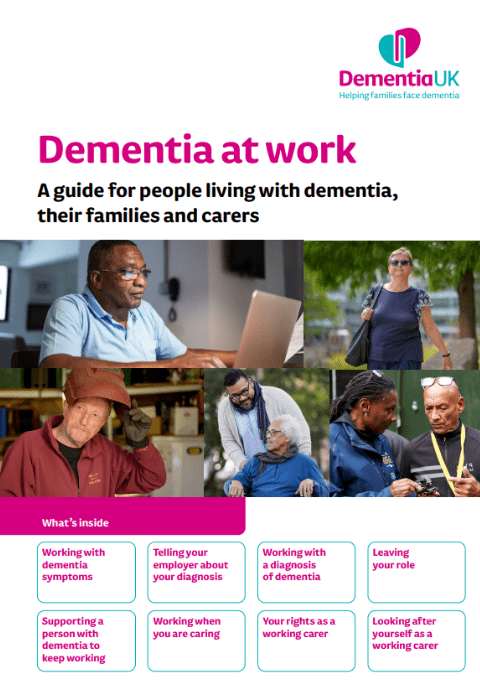
We have produced a free, downloadable guide to help you manage your working life if you are living with, or caring for someone with, dementia. Written by our Admiral Nurses, it contains essential advice for people who are working and living with dementia. It also contains information and advice for people who are working while caring for someone with a dementia diagnosis. Download the guide and you'll also be able to read experiences and advice from other people whose working lives have been affected by dementia.
Our virtual clinics give you the chance to discuss any questions or concerns about dementia, including young onset dementia, with a dementia specialist Admiral Nurse by phone or video call, at a time that suits you.
Philip, who is living with young onset dementia, shares how his love of cricket helps him stay mentally active.

Andy opens up on how his approach to his dementia diagnosis has changed over time, and the two layers of stigma he has experienced.

Glenn shares how flexible working arrangements and support from his managers enables him to continue working whilst prioritising his wife Helen's care.