
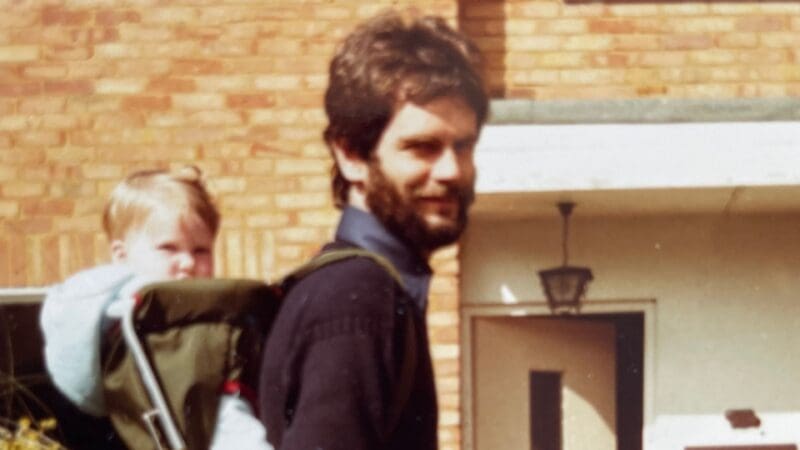
Kate’s story – “I’m a classic example of a sandwich carer”
Kate reflects on the challenges of being a sandwich carer and shares how her Admiral Nurse has supported her family.
Kate reflects on the challenges of being a sandwich carer and shares how her Admiral Nurse has supported her family.
My dad lived in Northern Ireland as a young child before moving to England when he was seven years old. He went on to study at Cambridge University and had a fantastic career as a journalist.
Dad loved music, reading and walking. He travelled a lot as he got older, I’m so glad he did as now he can’t. He’s a very gentle and kind person and is a self-described feminist. Even now, in the later stages of dementia, he’s so affable and sweet.
I grew up in London with my parents and two siblings. We all still live close by. I now have two children of my own, aged six and nine.
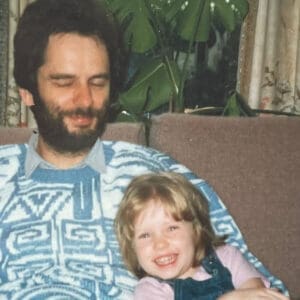
Kate and her dad
As Dad approached 70, he started talking about retiring. I remember him saying that he was struggling with his memory. At the time, I brushed it off and encouraged Dad to keep working as he loved his job. Then Covid hit and he decided it was the right time to retire. When I visited after lockdown, Dad sometimes struggled to recall words. I put it down to the fact that he was home a lot and wasn’t used to socialising.
Then the signs become more obvious. Dad used to go walking with friends and he started to lose his balance and had a number of falls. That’s when we decided to go to the GP. But it took over a year to get a diagnosis. Dad would pass the memory tests as he could still recall things quite well and put on a show for the doctor. It was hard to persuade them that something was wrong. He was eventually referred to a neurologist and diagnosed with mixed dementia aged 73. The diagnosis wasn’t at all a surprise, so it was incredibly frustrating that it had taken so long. We weren’t really left with much support afterwards.
Dad deteriorated really quickly. He would wander off on his own and get lost. Dad started getting up in the middle of the night or very early in the morning when Mum was asleep and would often fall. He ended up injuring his neck and was admitted to hospital.
Dad had to wear a neck brace but kept trying to take it off. He could have broken his neck without the brace, so he ended up being in hospital for a really long time. Dad was just lying there staring at the ceiling for months. He shared a room with other people which was hard for him. Dad ended up being in hospital for nearly three months.
The hospital finally discharged Dad to a care home once a place became available. It was a relief as he finally had his own room, and we knew he would be well looked after. But Mum found it really difficult. I think she wanted to keep caring for him at home, but we could see how hard it was for her to keep him safe.

Kate and her dad
A dementia specialist Admiral Nurse, Debi, got in touch with my mum once Dad was in the care home. Mum told me how helpful she was and that I could also call her for support, so I did. She was so lovely; I could feel her kindness through the phone. She is also from Northern Ireland and cared for her own dad, who was living with dementia. We had a lot in common, and it was comforting to speak to someone who understood what I was going through.
I was initially worried about taking my children to the care home because I thought they might find it distressing. But Debi said that I might be surprised at how resilient the children are and that I should maybe consider taking them in. I took her advice and it was the best decision. The children really enjoy going to the care home and seeing their grandad. They have only ever known him with dementia, so it isn’t scary for them. They bring a light energy to the visit, and the other residents enjoy seeing them too.
Debi also visits my dad in the care home and it’s reassuring to hear that she thinks that it’s meeting his needs. She’s familiar with the care home and staff and can advocate for us if we need it in the future.
Debi also said I could contact her whenever I need to. It’s a relief to know that she’s there, and I can talk to someone who understands what I’m going through.
Dad is in the later stage of dementia now. He can’t walk anymore; even sitting is challenging for him. He is mostly bedbound and has a special chair that he can be strapped into. I always explain who I am when I visit and he always smiles and says hello but I’m not sure if he really knows who I am. I constantly get asked by other people if dad still recognises me. I think a parent forgetting who we are is a big fear for many of us. Dad has still retained his gentle nature, which we’re grateful for.
When Dad was diagnosed, I had a baby and a toddler and was struggling to balance everything. I’m a classic example of a sandwich carer. It’s been really tough and it’s all a bit of a blur now. Before Dad went into the care home, I would take him out for some fresh air to give Mum a break. I remember taking both children and Dad to the park, tying all their shoe laces and getting their coats on. Then when we arrived at the park, they would all wander off in different directions. It was exhausting.
My children are six and nine now, and I still feel like I’m constantly being pulled in different directions. Showing up for school plays, care home visits, whilst also working full-time in charity communications. The responsibility is heavy and I always feel like I’m spread too thin. I’m trying to parent my children while quietly mourning the slow loss of my own parent. I’m often upset and my children don’t understand why. I worry that my grief might overshadow their childhood.
But I now know that it’s okay to feel conflicted. I can hold joy in one hand and grief in the other. It’s important to have compassion for ourselves and the people we love.
Dementia is still shrouded in secrecy, and people don’t talk about it very openly. None of my friends’ parents have dementia and I couldn’t find many people talking about it online. But I love writing and started my own blog, which has given me a way to connect with people who are in situations like ours. It’s so comforting to know that other people have been through a similar experience.
I couldn’t believe it when Debi said she had supported over 500 families in London. It made me realise how many people living close by are affected by dementia. The Admiral Nurse service is crucial and means the world to families like mine.
Kate reflects on the challenges of being a sandwich carer and shares how her Admiral Nurse has supported her family.

Mike reflects on the importance of the Nationwide Building Society dementia clinics in North Ayrshire, Scotland.

Harjit reflects on the support she received from Admiral Nurse, Tina, whilst her mum was in hospital.