
Join our Campaigns Network
If you are living with or caring for someone with dementia and would like to help improve dementia care, please join our Campaigns Network.

There are persistent gaps and failures in health and social care services.
And these gaps prevent people with dementia from receiving tailored, high-quality care at the end of life.
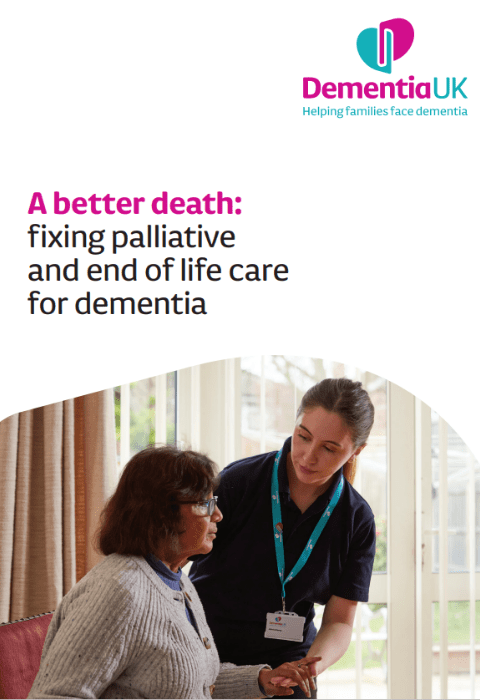
Our report, ‘A better death: fixing palliative and end of life care for dementia’, explores the experiences of families, carers and professionals across the UK.
We’ve found:
Palliative care aims to improve the quality of life of individuals who have a life-limiting illness.
The National Institute for Health and Care Excellence (NICE) guidelines set out that palliative care aims to provide relief from pain and other distressing symptoms, integrate the psychological, social and spiritual aspects of the person’s care, and continue to offer a support system to help people to live as actively as possible until their death.
End of life care overlaps with this approach but focuses specifically on the final year of life, including the last days and weeks when death is imminent.
People living with dementia and their families often don’t receive timely, compassionate and coordinated palliative and end of life care.
Symptoms go unrecognised and unmanaged. Families navigate fragmented health and social care services alone. Many are not supported to plan ahead.
More than a quarter of people with dementia die in hospital, even though many would prefer to die at home.
The evidence is clear: dementia must be recognised and treated as a life-limiting condition from the point of diagnosis.
We need to see improvements in palliative and end of life care such as:
This will deliver proactive palliative and end of life care.
And meet the needs of every family affected by dementia.
This report sets out clear, practical recommendations for governments and health and care leaders across the UK. With decisive action, we can transform palliative and end of life care for people with dementia, so that no one faces dementia alone.

Read Jenny's story"Anne initiated a conversation with Dad about Mum’s end of life care. I’d had similar conversations with him, but he seemed to accept it more easily coming from an Admiral Nurse".
If you are living with or caring for someone with dementia and would like to help improve dementia care, please join our Campaigns Network.
Information and resources about young onset dementia, where symptoms develop before the age of 65.
We’re campaigning for better care so that everyone affected by dementia gets the specialist support they deserve.